Unpacking Cross-Referencing Techniques Used by Specialists to Maintain Accuracy in Multi-Discipline Betting Guidance
Casey Richter · Aug 25, 2026
Unpacking Cross-Referencing Techniques Used by Specialists to Maintain Accuracy in Multi-Discipline Betting Guidance
Specialists handling multi-discipline betting guidance rely on structured cross-referencing to align projections across football, horse racing, basketball, tennis and other fields, and these methods draw from layered datasets that update continuously through league schedules and circuit events. Observers note that the process begins with raw inputs from official statistics providers, followed by direct comparisons against historical benchmarks in each discipline, which helps isolate anomalies before final selections reach subscribers. Data shows that teams managing advisory platforms in August 2026 continue to refine these steps amid expanded global markets and schedule disruptions.
Core Principles of Cross-Referencing
Researchers have documented how cross-referencing operates through sequential validation stages where one dataset confirms or challenges another, and this approach applies equally to soccer halves, turf sprints, basketball props and tennis tiebreaks. Experts at institutions such as the University of Nevada, Las Vegas Center for Gaming Research track these patterns in published studies that examine how forecasters integrate injury reports with weather data and travel schedules. The reality is that single-source reliance often produces drift, whereas multi-source checks reduce variance in outcome projections across athletic disciplines.
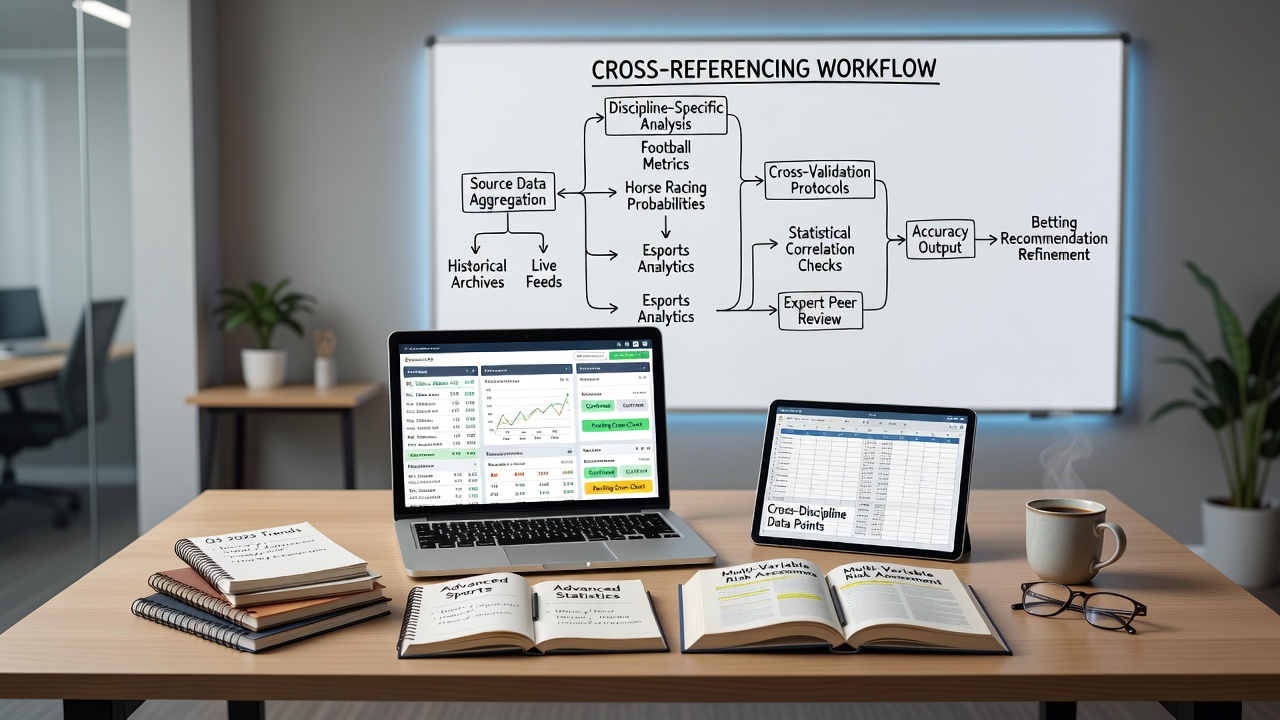
Those who study verification protocols observe that specialists first isolate key variables such as player availability, track conditions and recent form, then run parallel queries through independent databases before merging results. This creates a redundancy layer that surfaces inconsistencies early, and figures from industry reports indicate measurable improvements in consistency when these steps occur daily rather than weekly. And because markets move quickly in August 2026, platforms that automate parts of the comparison still require human review to handle edge cases like last-minute roster changes or equine health updates.
Practical Application Across Disciplines
Take one research team that examined how soccer analysts cross-check domestic league metrics against international tournament data, while simultaneously validating horse racing selections against circuit-wide speed figures. The process links quantitative outputs such as expected goals models with qualitative notes from track reports, producing a unified projection that accounts for both athletic and environmental factors. Studies found that this method surfaces correlations that single-discipline models miss, particularly when schedule congestion affects multiple sports at once.
Specialists also apply temporal cross-referencing by comparing current season metrics against equivalent periods in prior years, adjusting for rule changes or roster turnover. Observers note that in basketball, for instance, half-time totals receive extra scrutiny through parallel checks against NBA injury databases and college feeder trends, and similar layering occurs in tennis where surface-specific performance histories undergo verification against head-to-head records. Data indicates these combined checks contribute to steadier accuracy rates even during high-volume periods like the summer circuit swing.

Technology and Human Oversight Integration
Platforms now deploy algorithms that flag discrepancies across datasets in real time, yet human specialists retain final authority to interpret context that automated systems overlook. According to reports from the Canadian Gaming Association, hybrid workflows combining machine-assisted matching with expert judgment yield tighter error margins than either approach alone. Those managing advisory networks in August 2026 emphasize that the technology handles volume while specialists focus on edge conditions such as weather anomalies or regulatory shifts affecting specific tracks or leagues.
One documented technique involves building relational matrices that map variables from one discipline onto analogous metrics in another, allowing rapid validation of assumptions. For example, basketball prop projections undergo cross-checks against comparable historical samples from European leagues, and these matrices update dynamically as new results arrive. Research indicates that such structured mapping reduces confirmation bias because contradictory signals from independent sources trigger automatic review cycles.
Verification Networks and Record Integrity
Community validation networks play a documented role by circulating anonymized selections for peer review before publication, and this additional layer catches discrepancies that internal teams might miss. Data from academic sources shows that platforms incorporating external feedback loops maintain higher long-term accuracy across varied athletic disciplines. Specialists handling multi-sport guidance therefore maintain audit trails that log each cross-reference step, creating traceable records that support both subscriber transparency and internal quality control.
In practice, the workflow often follows a sequence where initial projections receive automated scans against multiple public and proprietary sources, followed by targeted manual review of flagged items. This sequence repeats across football, racing, basketball and tennis selections, with particular attention paid to linked bets that span disciplines. The approach ensures that any single data point influencing multiple outcomes undergoes repeated scrutiny before reaching end users.
Conclusion
Cross-referencing techniques used by specialists in multi-discipline betting guidance center on systematic comparison of independent datasets, integration of technology with expert oversight, and maintenance of verifiable audit trails. These methods support consistent projection fidelity across football, horse racing, basketball, tennis and related fields, and they adapt to evolving market conditions through August 2026 and beyond. Evidence from regulatory and academic sources confirms that layered validation contributes directly to record integrity and selection reliability in advisory platforms.